research
I study how strong gravity, magnetic fields, and radiation shape compact-object mergers, relativistic jets, and the signals we can observe from them.
Research projects
Five connected projects span scientific software, compact-object simulations, and radiation transport. Use the movie controls to play, pause, or enter full screen; the movies contain no audio.
Binary neutron star mergers
Across complementary simulations, I study how the equation of state, neutrino transport, magnetic fields, spin, and remnant lifetime shape merger ejecta, nucleosynthesis, and the conditions for jet formation. The movie shows a black-hole–disk incipient jet propagating through the dense polar outflow launched by the massive-neutron-star remnant before its delayed collapse.
A jet pushing through its environment
Synchronized meridional views of rest-mass density, radial velocity, magnetic-field strength, and magnetization show the incipient black-hole–disk jet interacting with the polar outflow launched before collapse.
Read the paperSupermassive black hole binaries
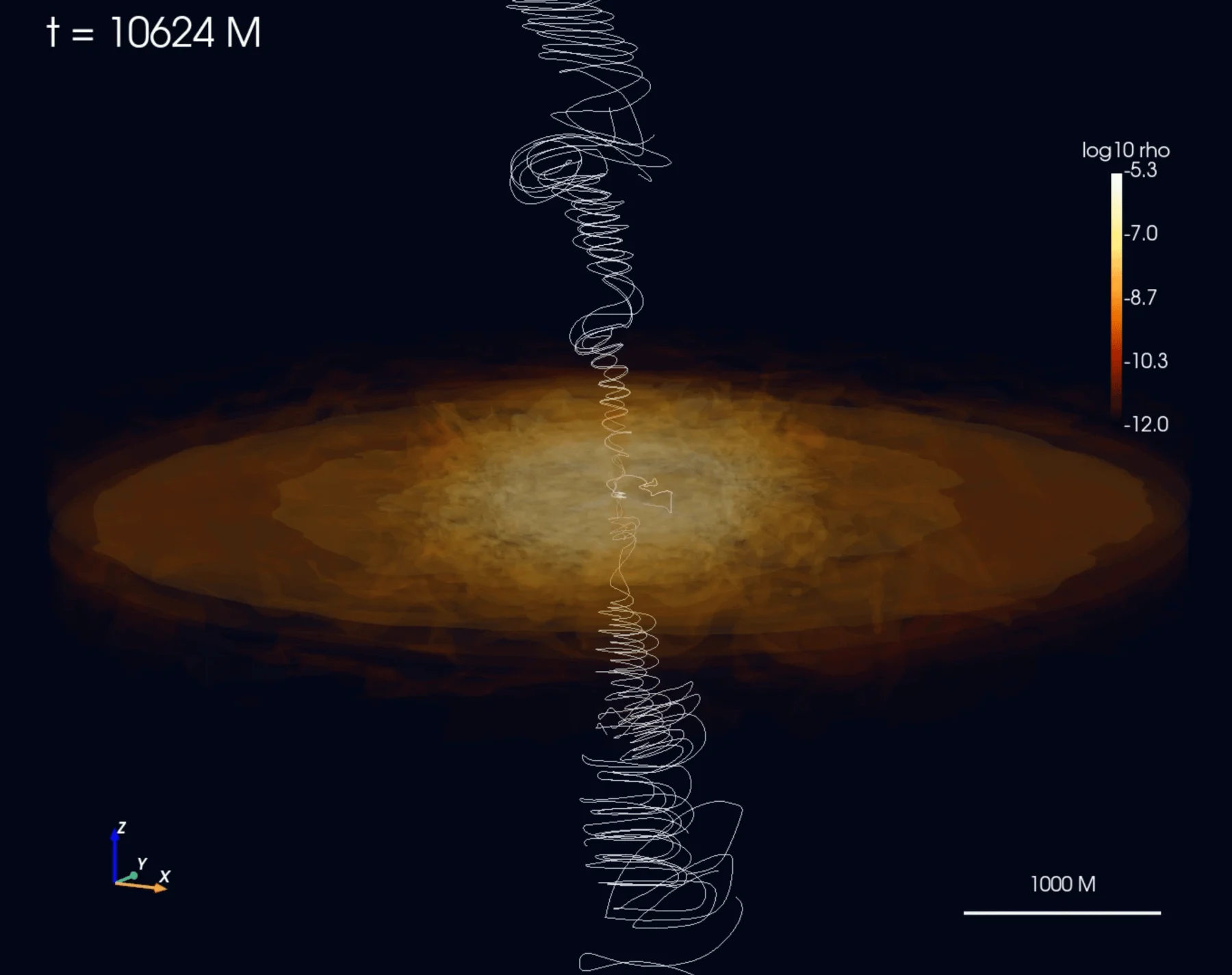
Three-dimensional GRMHD simulations follow a precessing binary with mass ratio q = 1/7 embedded in a magnetized circumbinary disk. Repeated passages of the secondary through the inner accretion flow alternately load the two jet funnels, producing quasi-periodic outflows; the jet also precesses, reverses its magnetic handedness, and undergoes two weakening episodes.
Related preprintDisk–binary interaction
Equatorial and meridional density views reveal how the asymmetric binary reshapes the accretion flow.
Global jet structure
A wide 3D view of the circumbinary disk and the evolving magnetic-field geometry associated with its jet.
Near-zone variability
A closer view of the binary, surrounding density structure, and time-dependent magnetic geometry.
AsterX — GPU-accelerated GRMHD code
AsterX is an open-source, modular, GPU-accelerated GRMHD code for dynamical spacetimes, built on CarpetX/AMReX within the Einstein Toolkit. It supports block-structured adaptive mesh refinement, high-resolution shock capturing, and tabulated equations of state; weak-scaling tests reached 4,096 Frontier nodes with 67–77% efficiency relative to eight nodes.
AsterX repositoryKelvin–Helmholtz instability
The background shows the density field; passive tracer particles, colored by fluid velocity, follow the Kelvin–Helmholtz roll-up across the adaptive mesh.
Magnetized post-merger remnant
Rest-mass-density isosurfaces and selected field-line tracers, colored by magnetic-field strength, visualize the turbulent post-merger remnant.
nuX — GPU-accelerated M1 neutrino transport code
nuX evolves the zeroth and first angular moments of the neutrino radiation field using an M1 closure on GPUs and is designed to couple with AsterX. It supports multi-species neutrino transport and neutrino–matter source terms for cooling, heating, composition evolution, and radiation stress–energy feedback in neutron-star-merger and core-collapse simulations.
nuX repository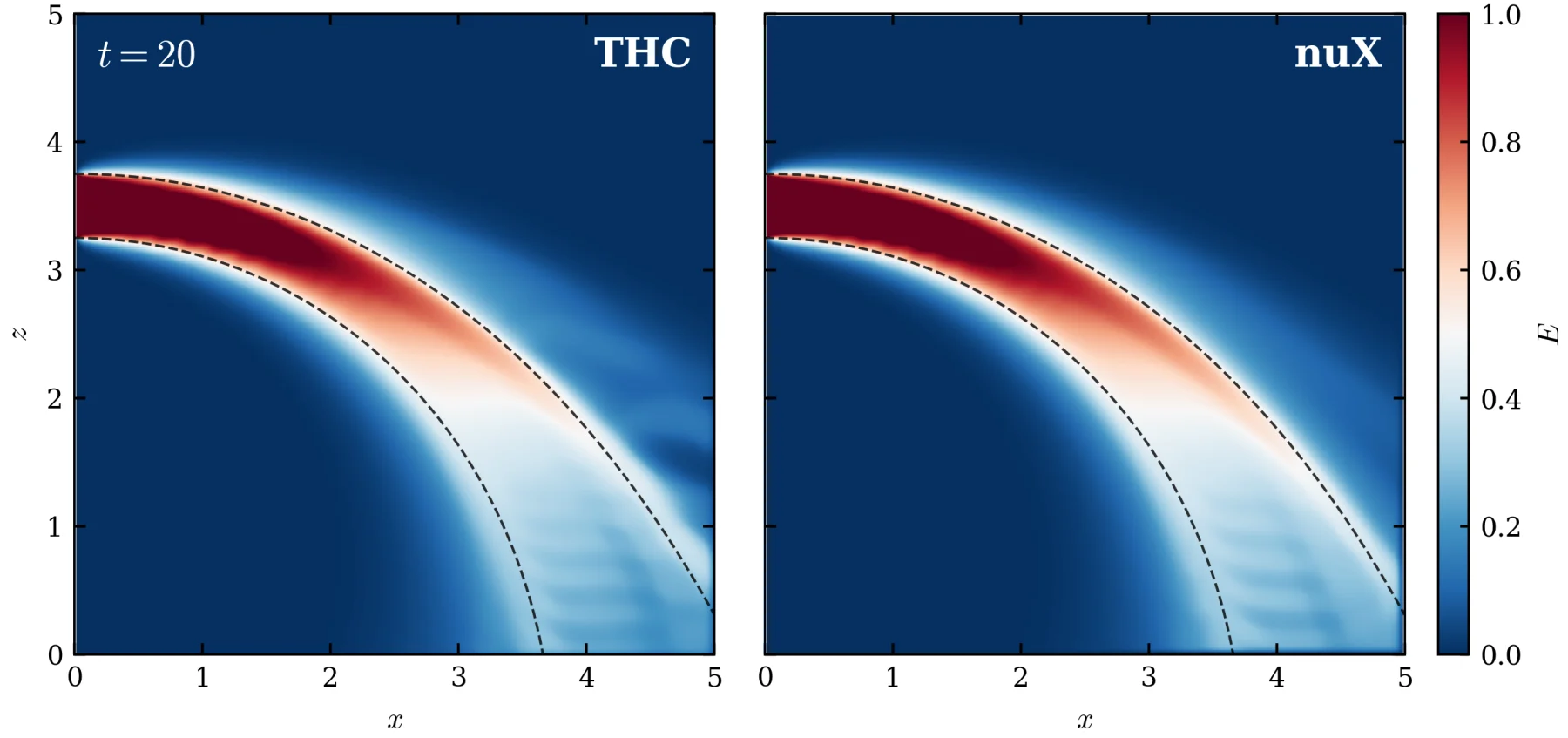 nuX · M1 transport
Curved-spacetime beam bending
At t = 20, the THC and nuX radiation-energy-density solutions both track the dashed reference envelope in this curved-spacetime beam-bending test.
BHClusterX — Bowen–York initial-data code for N black holes
BHClusterX constructs Bowen–York initial data for systems of N black holes within the Einstein Toolkit. It provides a foundation for simulations of relativistic black-hole clusters, including hierarchical mergers in which remnants of earlier coalescences merge again.
BHClusterX repositoryA moving black-hole quartet
The conformal factor ψ visualizes the evolving geometry as four initially separated black holes move inward and merge to form a single, more massive black hole.