Jay Kalinani
Postdoctoral researcher · University of Illinois Urbana–Champaign
Hi, I'm Jay!
I use supercomputers to follow some of the universe’s most extreme cosmic encounters—from the turbulent aftermath of neutron-star collisions to the luminous dance of gas around merging supermassive black holes.
I am a postdoctoral researcher in Prof. Helvi Witek’s Gravity Group at the University of Illinois Urbana–Champaign. My work sits at the crossroads of astrophysics, numerical relativity, and high-performance computing. I turn the equations of strong gravity, magnetized matter, and radiation into GPU-accelerated simulations built to run at exascale, connecting cosmic collisions to relativistic jets, kilonovae, gamma-ray bursts, and gravitational-wave sources.
I earned my Ph.D. in Physics from the University of Padova under the supervision of Dr. Riccardo Ciolfi. Before joining Illinois, I held a postdoctoral appointment at the Center for Computational Relativity and Gravitation at Rochester Institute of Technology, working with Prof. Manuela Campanelli.
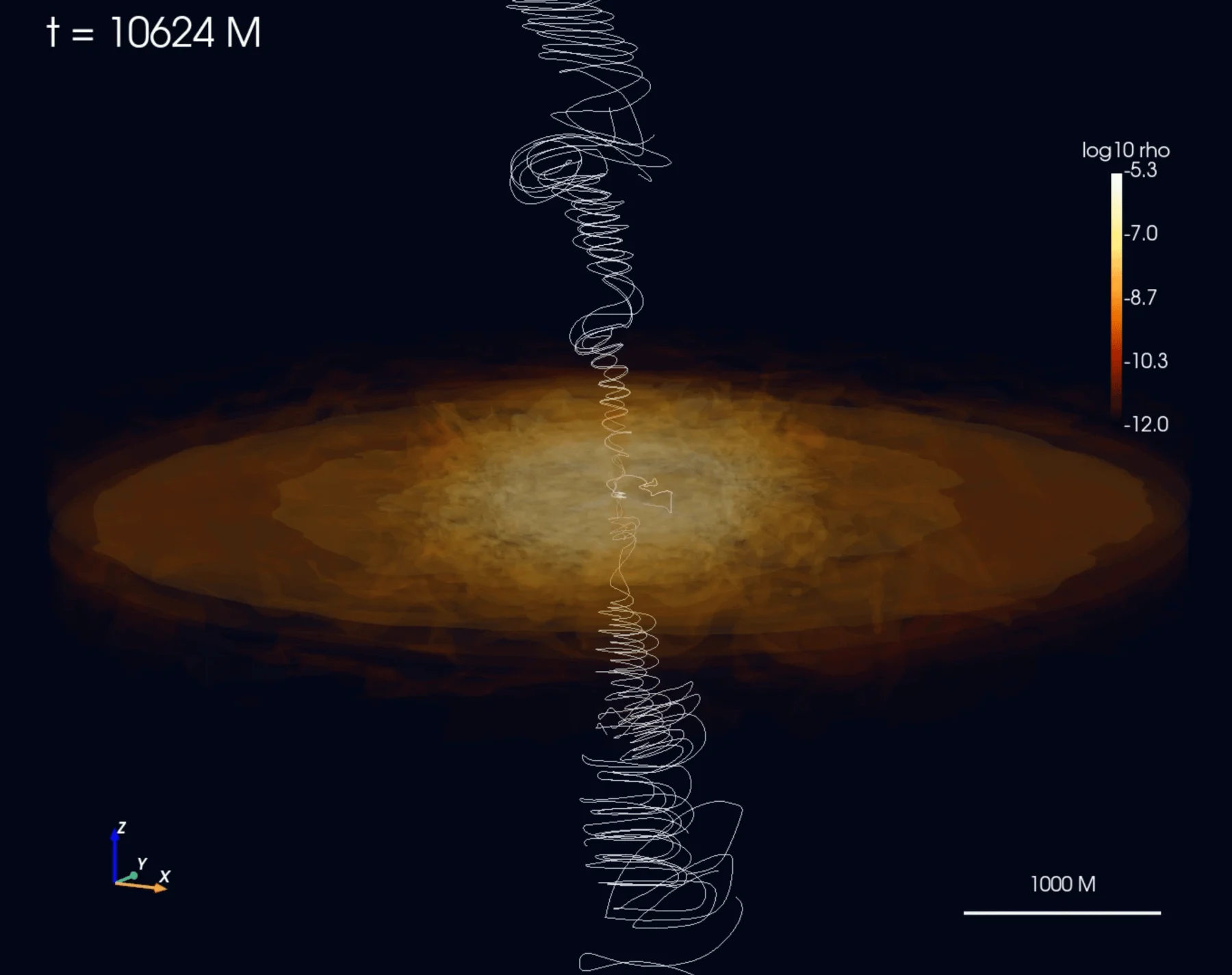
Research at a glance
Two cosmic laboratories anchor my research, supported by the GPU software that makes their simulations possible at scale.
Binary neutron star mergers
I study the hot, magnetized remnant after collision: how turbulence amplifies magnetic fields, the conditions under which relativistic outflows emerge, and how merger ejecta contribute to r-process nucleosynthesis and kilonova emission.
Merging supermassive black hole binaries
I study how gas responds to the evolving binary spacetime, feeds the individual black holes, and drives variable electromagnetic outflows as these systems approach merger.
Codes for the exascale era
To make these calculations possible, I lead AsterX, a GPU-accelerated GRMHD code, and develop nuX for GPU-accelerated M1 neutrino transport.